
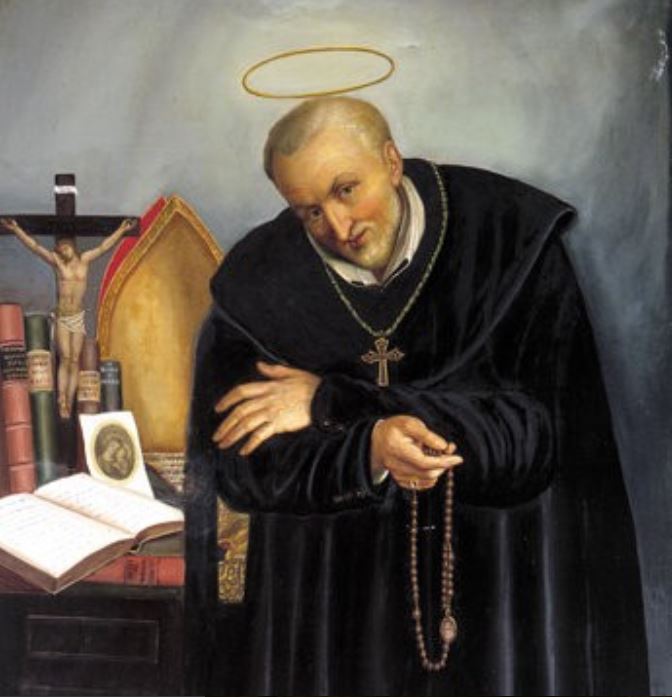
NOTICE.
WE begin the series of works composed especially for the clergy. The work that comes first appeared in 1760 after the True Spouse of Jesus Christ, when the author had attained the age of sixty-four. It is the fruit of researches and of studies that he had made during nearly forty years, either for the purpose of regulating his own conduct, or of directing ecclesiastical retreats, and exercises which, by order of the archbishop, he preached for the first time to the clergy of Naples, in 1732, when he had been a priest only six years. He was then regarded as a model for imitation, and as a master worthy of being entrusted with the duty of educating ministers of the sanctuary of every grade.
This book is one that has had most success, thus giving us a high idea of the good that it has effected. It was at once translated into the principal languages of Europe. There are at least five translations of it in French, among which the translation by Mgr. Gaume, an author of very many valuable works, deservedly holds a high rank. To several of these translations the first word of the Italian title Selva 2 has been given, the word Selva meaning wood, forest, material, collection of the translation of this we give as the sub-title of the work. We have, however, preferred to give to this work and to this volume a title that clearly expresses its aim, namely, DIGNITY AND DUTIES OF THE PRIEST.
1 Volumes XIII. and XIV. treat of the Holy Mass and of the divine Office; volumes XV. and XVI. of missions and of preaching, and a subsequent volume containing Pastoral letters.
2 Selva di materie predicabili ed istruttive, per dare gli esercizj ai Preti, ed anche per uso di lezione privata a proprio profitto ; The author informs us in his preface that he did not endeavor to put much order into the collection of ideas suitable for each subject; we, however, perceive that there is more order in it than he would have us believe.
In order the better to understand the author, we have, as much as possible, divided each subject into paragraphs; by such an arrangement the subjects are not only more easily grasped and retained, but we may most conveniently use this book either for meditation or for spiritual reading.
We think it to be not amiss if we call to mind what we have elsewhere said, namely, that all the citations from authors, accompanied by references to the margin, have been carefully verified and corrected when necessary. St. Alphonsus was not always able to draw from original sources: he was often obliged to content himself with what was offered him by the authors whom he had at hand, and who themselves only reproduced the mistakes of their predecessors, which were increased by the mistakes of copyists or of printers. Hence it was necessary to consult the original texts in order to obtain exact citations.
As to the value and utility of this Collection, we take pleasure in quoting the following passage from the preface of Mgr. Gaume:
“We have Massillon, Sevoy, le Miroir du clergé What have you are three authorities that are without doubt respectable; but they are, after all, private authorities, and your reason, so often the dupe of such authorities, hesitates, distrusts, and using its right, judges, adopts, rejects, and never raises itself to a philosophical faith. Useful at all times, these works monuments of eloquence or of piety suffice no longer at the present day.
To the vast development of error we must oppose the analogous development of truth; to this invasion of private spirit we must oppose the imposing authority of the Catholic spirit. Read Selva, and say whether it is possible to reach this end in a better manner. Here is not mans thought that is given to you as a rule for your thought: it is the thought of ages; it is not the Bishop of St. Agatha;1
it is solely tradition that preaches that instructs, that forbids, that commands, that encourages, or that terrifies. This book is as a sacred tribune from which speak one after another the prophets, the apostles, the apostolic men, the martyrs, the solitaries, the most illustrious pontiffs of the East and the West, the most famous Doctors, the most skilful masters of the science of the saints, the successors of St. Peter and the councils, the organs of the Holy Ghost; in a word, antiquity, the middle ages, modern times, the entire Church.
“In the midst of this august assembly what does the holy bishop do? Nearly always he limits his task to the modest role of a narrator; often even he leaves to you the care of drawing conclusions. There are no long reasonings, inductions, special interpretations. In this consist the particular merit and providential character of Selva. More than at any other epoch did the world and the clergy, who should save the world, stand in need of Catholic thought, and the saint gives it pure and entire; he feared to weaken it by mingling his own with it.” 2
1 St. Alphonsus was not yet a bishop when he published this work; he was appointed to this office two years later.
2 We read in a treatise entitled L INFALLIBILITE ET LE CONCILE GENERAL, ch. 8, written by Cardinal Dechamps, a note that is to the point. After having called St. Alphonsus “the most faithful and the most powerful Echo of tradition in modern times,” the eloquent Cardinal explains that our author was, however, not a simple echo in his dogmatical, in his moral. .or in his ascetical works, on which he passes a eulogy which he concludes as follows: “Among his ascetical works there is one that St. Alphonsus has modestly entitled a COLLECTION of texts.” At first sight one might believe that this is true; but if one reads the book attentively one sees that the thought of the author is the framework of the whole, and that the strongest and the sweetest that tradition contains he skilfully adapts to the service of his pen.
We know that nothing is more difficult than the composing of such a work, in which the texts are not in juxtaposition, but are united by a living thought that revivifies them. If St. Alphonsus is an echo, it is after the fashion of St. Bernard. This judgment seems to us to be perfectly just; we thence conclude that our venerated author is an echo that thinks, that admirably chooses the most proper sounds to express his thought with an irresistible energy; but he also knows how to speak in another manner when the subject demands it, as one may especially see in his Fourth Instruction, in which he speaks of preaching and the administration of the sacrament of Penance.
This is the language of Mgr. Gaume, and we must acknowledge that such is in fact the power of this book; but this power is equalled by the unction that accompanies it, as is the case with the other works of this author, and both its unction and its power are supported by the example of his life. One may in some manner say of him what was said of our divine Saviour: Cœpit facere, et docere “He began to do and to teach” (Acts ii.).
The following are the rules of conduct that he composed for himself at the time he entered the ecclesiastical state, to serve for his guidance as a candidate for the priesthood:
1. The cleric should frequent the society of holy priests, to be edified by their example.
2. He should spend at least one hour daily in mental prayer, that he may live in fervor and recollection.
3. He should visit the Blessed Sacrament frequently, especially during the time of exposition.
4. He should read the lives of holy priests, that he may imitate their virtues.
5. He must cultivate a special devotion to the Holy Virgin, the Mother and Queen of the clergy, and consecrate himself particularly to her service.
6. For the honor of the ecclesiastical state he must be most careful of his reputation.
7. He should flee from worldly conversation, and not be too familiar with the laity, especially women.
8. Seeing God in his Superiors, he must obey them, because such is the divine will.
9. He should be modest, but without affectation, severity, or fastidiousness; and he should always wear the cassock and tonsure.
10. He should be quiet and gentle at home, exemplary in class, and edifying in church, especially during the public offices.
11. He should confess every eight days, and communicate still oftener.
12. He should live free from sin, and practise every virtue.
The young Levite, whose virtue and talents we have admired in another career, edified the whole city of Naples by a constantly increasing fervor while ascending the different degrees of the sanctuary. At the end of a preparation of three years he was judged worthy to be elevated by a dispensation to the dignity of the priesthood. This took place December 21, 1726. He then wrote the following resolutions:
1. I am a priest; my dignity is above that of the angels. I should then lead a life of angelic purity, and I am obliged to strive for this by all possible means.
2. A God deigns to obey my voice. I should with far greater reason obey his speaking to me through his inspirations or my Superiors.
3. The holy Church has honored me: I must therefore honor myself by sanctity of life, by my zeal and labors, etc.
4. I offer to the Eternal Father Jesus Christ, his Son it is then my duty to clothe myself with the virtues of Jesus Christ, that I may become fit for my office.
5. Christian people see in me a minister of reconciliation, a mediator between God and man; consequently I must always keep myself in the grace and friendship of God.
6. The faithful desire to see in me a model of the virtues to which they should aspire; I must then be edifying always and under all circumstances.
7. Poor sinners that have lost the light of grace come to me to be spiritually resuscitated: I must therefore aid them by my prayers, exhortations, and good example.
8. Courage is necessary to triumph over the world, the flesh, and the devil; I must then correspond with divine grace that I may combat these virtues victoriously.
9. To defend religion and fight against error and impiety, one must have knowledge. I will then strive, by every means within my reach, to acquire the necessary knowledge.
10. Human respect and worldly friendships dishonor the priesthood; I will then avoid them.
11. Ambition and self-interest have often caused priests to lose their faith; I must then abhor these vices as sources of reprobation.
12. Gravity should accompany charity in a priest; I will then be prudent and reserved, especially with regard to women, without being proud, rough, or disdainful.
13. I can please God only by recollection, fervor, and solid virtue, which nourish the holy exercise of prayer; I will then neglect nothing which may tend to their acquisition.
14. I should seek only the glory of God, my own sanctification, and the salvation of souls; consequently, I must achieve these ends though it should cost my life.
15. I am a priest; it is my duty to inspire virtue in all with whom I come in contact, and to glorify Jesus Christ, the eternal High-priest. (Villecourt, 1. i, ch. 11.)
Such was the aurora of this star that was to pass through so grand a career, and raise itself to so high a perfection. Quasi lux splendens, procedit, et crescit usque ad perfectam diem “As a shining light goeth forwards * and increaseth even to perfect day” (Prov. iv. 18).
Our saint is already recognized as one of the purest lights that God has sent to illumine the world. Quasi sol refulgens, sic ille effulsit in templo Dei “As the sun when it shineth, so did he shine in the temple of God” (Ecclus. 1. 7). A new ray has been added to his glory: he has been declared a Doctor of the Church. Let us not omit to profit by his teachings and imitate his virtues in order that we may one day share in his eternal happiness.
Live Jesus, Mary, Joseph, and Alphonsus !