
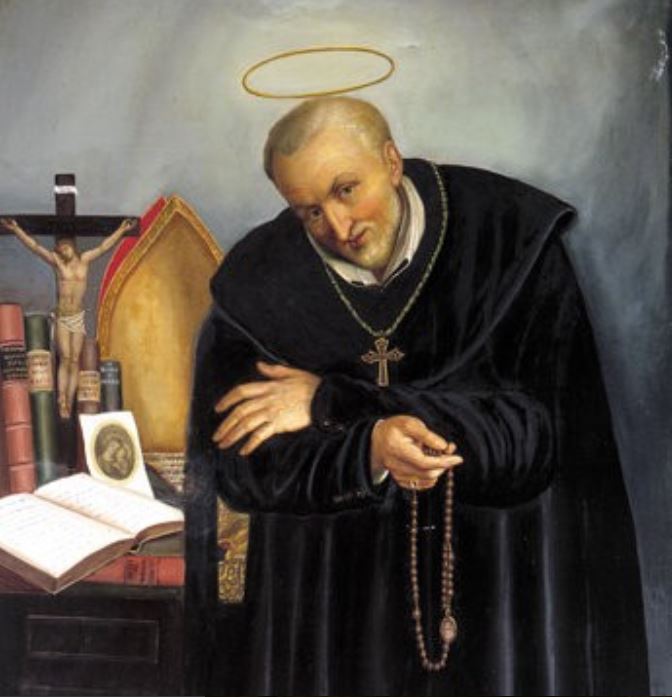
SPIRITUAL RULES FOR A PRIEST WHO ASPIRES TO PERFECTION.
1. TO AVOID SIN, AND TROUBLE AFTER SIN.
A PRIEST who aspires to perfection and desires to sanctify himself should, above all, endeavor to avoid more than death the least deliberate venial sin. In the present state of human frailty, since Adams sin, no one can, and no one ever could, with the exception only of Jesus Christ and his most Blessed Mother, be exempt from all indeliberate venial faults. With the help of God, however, every one can avoid every deliberate fault; that is to say, committed with full advertence and consent; thus the saints have acted. He, therefore, who tends to perfection should make up his mind rather to allow himself to be cut to pieces than to tell, with full knowledge, a lie, or to commit any other venial sin, however small it may be. Such should be his resolution; but if unfortunately he happens to fall into a fault, either deliberate or indeliberate, let him beware of troubling and disquieting himself. Disquietude does not come from God; it is a smoke that comes only from the abode of disquietude itself, namely, from hell; and it comes to us from that place because, as St. Aloysius has justly said, the devil always finds something to fish in troubled waters. When one has, for example, committed a fault one is troubled, and one is troubled because one has been troubled. In this state of disquietude we shall not only be unable to do any good, but we shall also easily commit many other faults, either of impatience or of some other kind. Hence, as soon as the fault has been committed, we must humble ourselves and immediately have recourse to God by making an act of love or of contrition with the firm purpose of amendment; then we ask with confidence for the grace of which we stand in need by saying: O Lord! see what I am able to do; and if Thou withdrawest Thy hand from me I shall do still worse. I love Thee; I repent of the displeasure that I have caused Thee, and I will do so no more; grant me the help that I hope to receive from Thy goodness.
After having done this we should be calm, as if we had not committed any fault; and if we fall back, even on the same day, let us do the same thing. Should we even fall a hundred times, we should always act in the same way, namely, we should humble ourselves, we should rise again, we must never remain down. It must be observed that to trouble ones self after a fault has been committed is an effect not of humility, but of pride; since we are sorry for the fault not because we have offended God, but rather because we are ashamed to appear before him so defiled. The priest should, therefore, never trouble himself on account of the faults into which he falls; but let him humble himself, acknowledging himself capable of committing these and other faults. Let him then make an act of love of God; thus this sin, instead of removing him from God, will serve only the more to unite him more closely to him, according to what the Apostle says: All things ” even sins,” 1 the Gloss adds work together unto good. 2
2. EFFICACIOUS DESIRE TO ADVANCE IN THE LOVE OF GOD.
Let him desire to advance without ceasing in the love of God. Not to wish to advance in perfection, which consists in the love of God, is to wish to go backward, says St. Augustine. 3 He that moves against the current of a river, and does not make continual efforts against the movement of the waters, will be driven back.
The same thing happens to us when we cease to struggle with the concupiscence of the flesh. Holy desires render our efforts easier, and help us to move forward; but it is necessary that these desires be firm and efficacious that is to say, that they be put in practice as much as possible. They should not resemble the desires of those that are content with saying, for example: Oh! if I had no brothers, no nephews, I would enter religion; if I had health, I would do this or that penance; and in the mean time these persons do not take a step forward in the way of God: on the contrary, they always commit the same faults, always keeping up the same attachments and the same animosities, and go from bad to worse. It is therefore necessary that we advance in divine love, but with the resolution to do on our part all that we can to attain this end. We must, however, entirely mistrust our own strength, and trust only in God; for as soon as we trust in ourselves we remain deprived of the help of grace.
1 “Etiam peccata.”
2 “Omnia cooperantur in bonum.” Rom. viii. 23.
3 “Non progredi, jam reverti est.” Epist. 17, E. B. app.
3. DEVOTION TO THE PASSION OF OUR LORD AND TO THE BLESSED SACRAMENT.
To advance in perfection the priest must, moreover, entertain a great devotion to the Passion of Jesus Christ and to the Blessed Sacrament. When we consider these two great mysteries of love, in which a God, to make himself loved, gives his life and makes himself the food of a worm of the earth, his creature, we cannot live without being inflamed with love for Jesus Christ. For the charity of Christ presseth us. 1
1 “Charitas enim Christi urget nos.” 2 Cor., v. 14.
He that thinks of the love of Jesus Christ will feel himself, as it were, forced to love him. St. Bonaventure calls the wounds of Jesus the wounds that wound the most hardened hearts, and that inflame with love for God the coldest souls. 1 Let the priest, then, always make as a usual thing, every day, a half-hours meditation on the Passion of Jesus Christ. Let him, besides, make during the day frequent acts of love to this good Master, beginning them on awakening in the morning, and endeavoring at night to fall asleep while making them. St. Teresa said that acts of love are the wood that keeps up in the heart the sweet fire of divine love. The act of love of God that is more especially agreeable to God is the offering that we make to him of ourselves by offering to do and to suffer all that will please him. St. Teresa repeated this act at least fifty times a day.
1 “Vulnera corda saxea vulnerantia, et mentes congelatas inflammantia.” Stim. div. am. p. 1 c. I.
4. THE INTENTION OF DOING ALL FOR GOD.
The priest should in all his actions take care to make his intention to do for God alone all that he does. The right intention is called by the masters of spiritual life a heavenly alchemy, which converts into gold all our actions, even corporal alleviations, such as sleep, eating, and recreation. But it is particularly necessary that the exercises of piety should be performed only to please God, and not for any interested motive, either of vain glory or self-satisfaction; otherwise all will be lost, and instead of a reward we shall receive only punishment. This is the reason why, in order to do surely for God all that we do, it is important that we always act in dependence on our director.
5. LOVE OF SOLITUDE AND OF SILENCE.
It is necessary that the priest should be a friend of solitude and of silence. He that treats too much with men, and speaks too much with them, will do well to be cautious; he will with difficulty escape sin: In the multitude of words there shall not want sin. 1 For this reason the Lord says: In silence and in hope shall your strength be. 2 Our strength against temptations is in confidence in God and in detachment from the society of creatures. Moreover, he that speaks much with men will rarely speak and treat with God. In solitude the Lord speaks and converses familiarly with souls, in accordance with the saying of St Jerome; “O solitude, in which God familiarly converses with his creatures!” 3 And he himself has informed us that it is in solitude that he speaks to our hearts: I will lead her into the wilderness; and I will speak to her heart. 4 Thus we see souls that burn with the love of God always seeking solitude. The saints went to bury themselves in the forests and in the most frightful caverns, in order not to be troubled by the noise of the world and in order to converse only with God. ” Silence and rest from noise,” said St. Bernard, “as it were, forces the soul to converse with God.” 5
Nevertheless the virtue of silence does not consist in always keeping silence, but in being silent when it is expedient. A good priest is silent when he should be silent, and speaks when he should speak; but he speaks only of God or of what concerns the glory of God and the good of souls. Often a word about God spoken familiarly in conversation will produce more fruit than many sermons. We should therefore be careful in all our conversations, however indifferent they may be, to allow some edifying word to glide into it on the eternal truths or on the love of God. When we love a person, we always wish to speak of him and to hear others speak of him; when we love God, we do not wish to speak of any one but of God, and we do not wish to hear any one spoken of except God.
1 “In multiloquio non deerit peccatum.” Prov. x. 19.
2 “In silentio et in spe erit fortitude vestra.” Is. xxx. 15.
3 “O solitude, in qua Deus cum suis familiariter loquitur ac conversatur!”
4 “Ducam eam in solitudinem, et loquar ad cor ejus.” Os. ii. 14.
5 “Silentiura. et a strepitu quies cogit cœlestia meditari.” Epist. 78.
6. CONFORMITY TO THE WILL OF GOD.
The love of God consists above all in conformity to his holy will, especially in regard to things that are mostly contrary to self-love, such as sickness, poverty, contempt, persecutions, spiritual aridities. We should be persuaded that all that comes from God is useful to us, since all that he does, he does for our own good; for there is no one that loves us more than God. If we wish to sanctify ourselves, let us say in all that happens to us: May Thy will be done! May the name of the Lord be blessed. O Lord! what wilt Thou have me do ? As it pleases the Lord, so let it be done. Let it be thus, O Father! because it was thus pleasing to Thee.
In all the occurrences of life, whether agreeable or disagreeable, let us endeavor to preserve this continual peace and this unalterable tranquillity, of which the saints have given us the example, always saying: In peace in the self -same I will sleep and I will rest.1 A soul that loves God, always united with its Lord, leads a uniform life. This is what is said by that great servant of God, Cardinal Petrucci, when speaking of the words of the Holy Ghost: Whatsoever shall befall the just, it shall not make him sad. 2 Thus a priest that loves God will never be afflicted. Sin only should cause him sorrow; but even this sorrow, as we have said above, should be a tranquil sorrow, that does not trouble the peace of the soul.
1 “In pace in idipsum dormiam et requiescam.” Ps. iv. 9.
2 “Non contristabit justum quidquid ei accident.” Prov. xii. 21.
7. DESIRE FOR DEATH.
The priest should often desire paradise, and consequently death itself, in order promptly to go to heaven, where he may love Jesus Christ with all his strength and during all eternity, without fear of ever losing him. In the mean time he should conduct himself towards God without reserve, not refusing him anything that he knows will be more agreeable to him; and he should be continually attentive to banish from his heart all that is not God or for God.
8. DEVOTION TO THE BLESSED VIRGIN.
He should endeavor to conceive a great confidence and a tender devotion to the Blessed Virgin. All the saints are always fond of nourishing in their hearts a filial piety towards this divine Mother. He should take care to make every day a spiritual reading out of a book that treats of the great confidence that we should have in her powerful protection. He should never fail as well as he is able to fast on Saturdays in her honor; and in all her novenas he should at least practise some abstinence and some other mortification. He should never omit to pay her a visit once or several times a day before some devout image. He should speak to others as much as he can of the confidence that we should have in the protection of Mary, and should endeavor on Saturdays to address in the church a little instruction to the faithful, so as to excite their devotion towards this charitable Queen; at least he should speak of her in a special manner in every one of his sermons, and recommend the same devotion to all his penitents and to all persons. The more one loves Mary, the more one loves God; for Mary draws to God all that love her. St. Bonaventure says: “Because she was inflamed with love, she also inflames all those that love her, and makes them like herself.” 1
1 Quia tola ardens fuit, omnes se amantes, eamque tangentes, incendit.” De B. V M. s. I
9. TO BE HUMBLE OF HEART.
Let the priest endeavor to be humble of heart. Many are humble in their speech, but not in their hearts; they say that they are the greatest sinners in the world, that they merit a thousand hells: nevertheless they wish to be preferred, esteemed, and praised; they strive after honorable employments; they cannot suffer a contemptuous word. The humble of heart do not act in this manner: they never speak of their talents, of their nobility, of their riches, or of anything that may be turned to their advantage. He should, therefore, love those employments and those works that are most humble and are less conspicuous. He should receive affronts without being troubled; he should even feel interior pleasure in seeing that he has become similar to Jesus Christ, who was filled with reproaches. Therefore, when he meets with some contradiction that wounds and irritates his pride he should do violence to himself not to speak nor act at that moment, even if he held the office of Superior, and as such is obliged to reprimand the insolence of him that offers the outrage. As long as he feels himself agitated he should keep silence and wait till he becomes calm, otherwise the smoke produced by his trouble will obscure his vision; he will believe that what he says or what he does is right, while all is faulty and disorderly. Moreover, when the correction is made amid agitation, the inferior will not receive it as a deserved reprimand, but as a passionate outbreak of temper on the part of the Superior; and this will make the correction useless, or nearly so.
For the same reason, when the Superior perceives that the inferior is troubled, he should put off the reprimand and wait till he has become calm; otherwise the inferior, blinded by his passion, will not only not receive the correction, but will even be moved to greater passion.
10. TO RENDER GOOD FOR EVIL.
The priest should try to be ready to assist every one, and especially to do good to him that has done him wrong, at least by recommending him to God. This is the way in which the saints take revenge.
11. INTERIOR AND EXTERIOR MORTIFICATION.
Let the priest be attentive to the practice of interior and exterior mortification. It was recommended by Jesus Christ when he said: Let him deny himself. 1 This is absolutely necessary in order to attain sanctity. Interior mortification exacts of us that we know how to conquer ourselves by refusing all that satisfies only our self-love. We should therefore abstain from every action that has no other object than to satisfy curiosity, ambition, or self-love.
We should also love exterior mortification, namely, fasting, abstinence, disciplines, and the like. The saints macerated their flesh as much as possible, that is to say, as much as obedience permitted, and obedience is the rule of the saints. As to him who, on account of ill-health, cannot impose upon himself exterior mortifications, he should embrace the pains and the inconveniences that he has to suffer by endeavoring to support them patiently and peacefully, and by refraining from making them known without necessity, and from complaining about the want of care on the part of the physicians or persons of the house.
1 “Abneget semetipsum.” Matt, xvi. 24.
12. TO PRAY WITHOUT CEASING.
We must always pray and recommend ourselves to God. All our good resolutions and all our promises end in smoke when we neglect to pray; for by not praying we are deprived of the necessary graces to carry them out. I will cry like a young swallow.1 We should always have the mouth open for prayer by saying: O Lord, help me! O Lord, mercy! O Lord, have pity on me! Thus the saints have acted, and it is thus that they sanctified themselves.
We should above all ask Jesus Christ for the gift of his holy love. St. Francis de Sales said that this gift includes all other gifts; for when we love God we try to avoid all that which is disagreeable to him, and to do all that we can do to please him. Let us also ask always for the grace of having great confidence in the Passion of Jesus Christ and in the intercession of Mary. Let us, moreover, not cease to recommend to God the poor souls in purgatory and poor sinners; for such prayers are most pleasing to God.
1 “Sicut pullus hirundinis, sic clamabo.” Is. xxxviii. 14.